


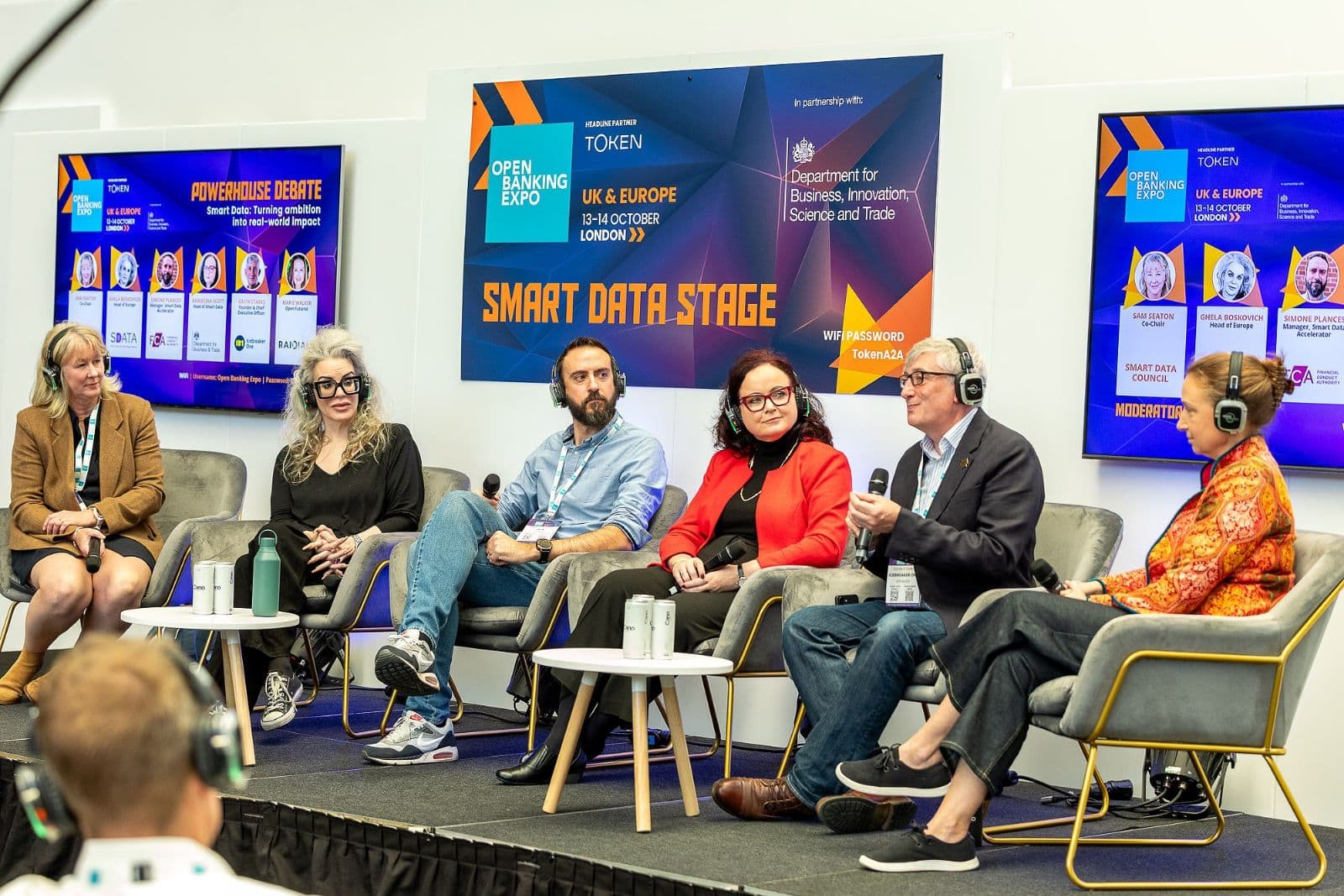
The Financial Conduct Authority (FCA) is preparing to test different infrastructure models for Open Finance, including centralised, decentralised and hybrid approaches, as it examines how agentic AI could transform financial data sharing.

Simone Plances, manager of the FCA’s Smart Data Accelerator
Speaking at Open Banking Expo UK & Europe 2026, Simone Plances, manager of the FCA’s Smart Data Accelerator, said the regulator was moving into a new phase of practical testing to determine which infrastructure arrangements would work best for the UK.
The work follows a series of technology and policy sprints, alongside the Prism Taskforce, which have helped the FCA identify the technical, commercial and regulatory challenges involved in developing Open Finance.
“We will be doing testing on different models of infrastructure for open finance. Specifically, what works for the UK?” Plances told delegates.
“What can be kept central? What can be decentralized, and why? And what roles and responsibilities come with that sort of design?”
The testing will help inform decisions about the architecture underpinning Open Finance, including how responsibilities should be distributed across participating organisations.
Agentic AI adds new complexity
Plances said the regulator was also examining how agentic AI could change the way financial data is accessed, shared and used.
“We really want to understand what happens when it’s not just consumers and firms and incumbents and data holders,” he said, referring to the introduction of AI agents into the ecosystem.
The FCA intends to explore what fully agentic data journeys could look like and identify the technical and regulatory challenges that must be addressed to establish trust.
The regulator’s work forms part of a wider government ambition to expand Smart Data beyond financial services into other sectors of the economy.

Agnieszka Scott, head of Smart Data at the Department for Business, Innovation, Science and Trade
Agnieszka Scott, head of Smart Data at the Department for Business, Innovation, Science and Trade, outlined the government’s ambition to establish five Smart Data schemes by 2030 and more than 20 by 2035.
However, she acknowledged the complexity of developing interoperable data-sharing arrangements across sectors with different governance structures, commercial incentives and regulatory requirements.
Industry warns against repeating Open Banking mistakes
While policymakers outlined their progress, industry representatives cautioned against allowing technical architecture to take precedence over genuine consumer and business needs.
Gavin Starks, founder and chief executive officer of Icebreaker One, warned that Smart Data could become fragmented if individual sectors developed incompatible approaches.
He questioned whether the UK was heading towards a “critical mass” of interoperable services or a “critical mess” of disconnected systems that increase costs and complexity.

Gavin Starks, founder and chief executive officer of Icebreaker One
Starks argued that businesses were not yet sufficiently prepared for cross-sector data sharing and that policymakers should prioritise practical use cases over generic technical frameworks.
“Pick an actual business problem or user need, and deliver it,” he urged.
Marie Walker, open futurist at Raidiam, echoed those concerns, drawing on work undertaken through an Open Property sandbox.
She said the project had exposed gaps in data readiness, standardisation and API availability, demonstrating why Smart Data schemes must be designed around real-world problems.
Walker also called for a more coordinated approach to common requirements such as privacy, consent and liability, rather than developing separate solutions for every sector.

Marie Walker, open futurist at Raidiam
Calls for universal consumer data rights
Ghela Boskovich, head of Europe at the Smart Data & Technology Alliance, argued that a universal consumer data right could help address inconsistencies in market readiness and create stronger incentives for organisations to participate.
She suggested that requiring firms across sectors to support data portability would encourage investment in the necessary infrastructure and governance arrangements.
Boskovich also called for large technology companies to be subject to comparable obligations, warning that inconsistent requirements could distort competition.

Ghela Boskovich, head of Europe at the Smart Data & Technology Alliance,
“There needs to be a push. There needs to be a mandate,” she said.
However, the panel acknowledged that implementation would be critical, with Australia’s Consumer Data Right cited as an example of the difficulties that can arise when schemes become overly complex.
The discussion highlighted the challenge facing policymakers as the UK seeks to move from Smart Data strategy to practical delivery.
While the regulatory foundations are developing, the panel emphasised that progress will ultimately depend on interoperability, commercial incentives and services that deliver measurable benefits to consumers and businesses.