

From Open Banking to Open Everything: Building Canada’s Smart Data future
OpenBankingExpo | Canada, News, Women In Open Banking
15 Apr 2026
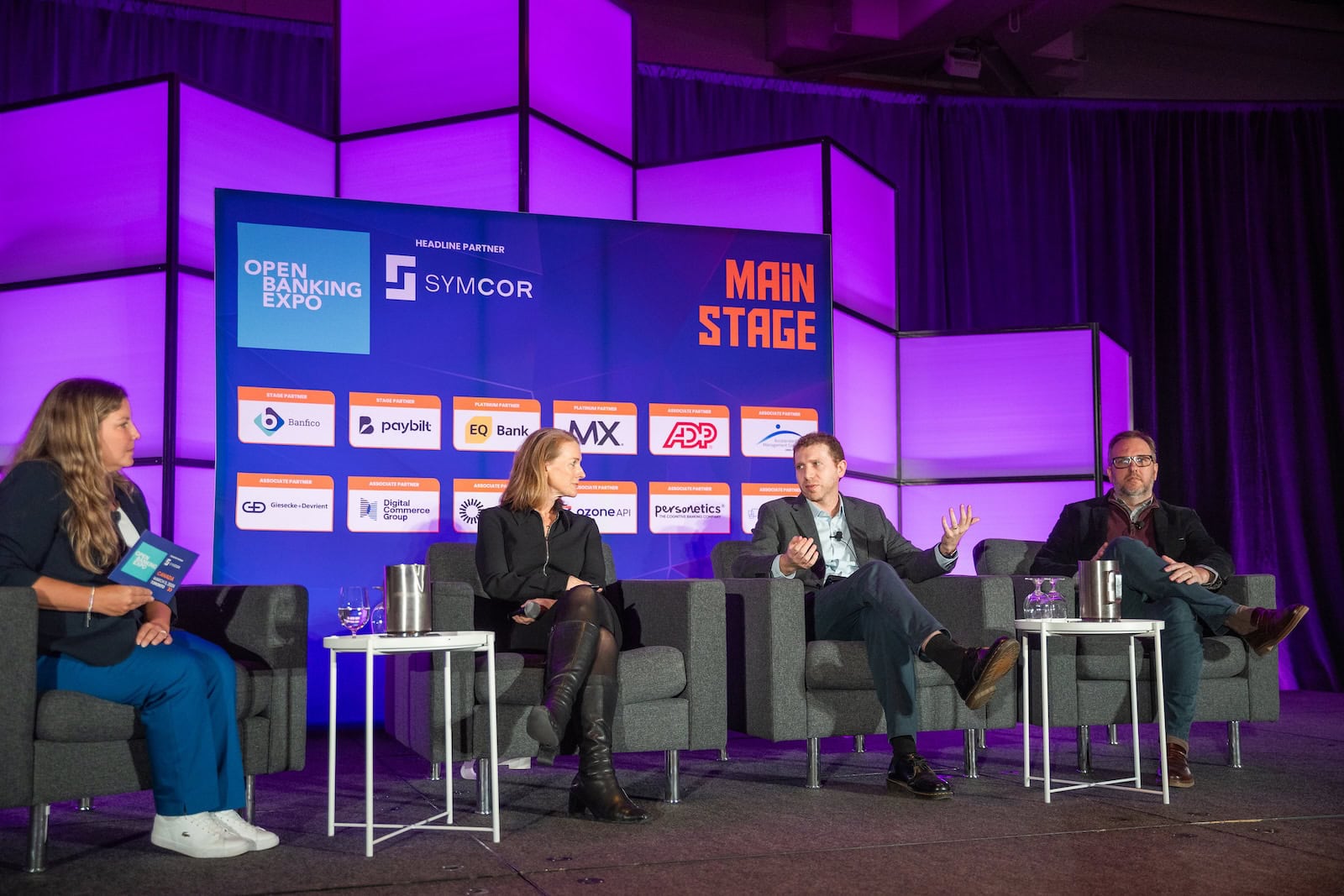
Attendees at Open Banking Expo Canada 2026 heard from senior leaders at MX, TSB and Open Finance Brasil about the shift beyond financial services toward a broader Smart Data economy.
Moderated by Michelle Beyo, chief executive officer of Finavator and president of the Open Finance Network of Canada, the discussion made clear that while Open Banking provides the foundation, the real opportunity lies in extending these principles across the wider economy.
Open Banking is the “first stepping stone”, Beyo said. “The next stepping stone is Open Finance. But the true dream lives in an Open Data economy,” she added.
Globally, that shift is already underway. More than 80 countries have implemented Open Banking frameworks, with a growing number progressing toward Open Finance and, in some cases, broader Open Data ecosystems, according to Beyo. Canada, after a prolonged policy development period, is now positioned to move forward, but panellists emphasised that speed and clarity will be essential.
Jane Barratt, chief advocacy officer at MX, highlighted the importance of shifting from data protection alone to data empowerment. Financial and health data, she noted, are among the most sensitive and valuable data sets.
“I think we have a moral obligation to leave the world better than we found it and a big part of that is how do we protect people’s data – and not just protect it, how do we actually help them improve their outcomes with their own data,” Barratt said. “We talk a lot about infrastructure, but how do we get data into the hands of people that can then put it to work for themselves?”
Taking inspiration from other countries
International examples provided further context for Canada’s next steps. Brazil’s Open Finance ecosystem was cited as a leading example of what can be achieved through clear regulatory direction and strong execution. With millions of users and businesses now participating, Brazil has demonstrated how integrating payments and data can drive rapid adoption and unlock new use cases, particularly for small and medium-sized enterprises.
Elcio Calefi, chief information officer at Open Finance Brasil, told attendees: “Since the beginning of Open Finance in Brazil in 2020, we knew what the scheme is that will be delivered, when the payment initiator will be delivered, when the credit portability will be delivered.”
He said that this gave participants and the market “the visibility [and] the stability” to make investments and that Brazil is now “seeing the benefits” of that decision by the Central Bank of Brazil.
Australia’s Consumer Data Right (CDR) has reframed data as a consumer-owned asset, enabling expansion into multiple sectors while reinforcing trust and transparency, Barratt explained.
In the UK, the Data Use and Access Bill will extend Open Banking infrastructure into areas such as energy and telecommunications – also known as Smart Data.
Adam Betteridge, fintech, partnerships and Open Banking lead at TSB Bank, said: “What we’re bringing to the UK will allow UK consumers, using Open Banking rails, to share other forms of data, whether that’s energy data, telecom data, potentially health data.”
Crucially, these new use cases will be built using the same infrastructure, rather than “rebuilding” or “replumbing”. “Ideally, over the next two to three years, we’ll see some really interesting use cases that benefit customers and small businesses,” he said.
Meanwhile, in the US, a more market-led approach has still resulted in significant adoption, driven by strong consumer demand and fintech innovation.
Looking ahead, panellists pointed to the increasing convergence of data, payments and digital identity as a critical enabler of the next phase. While Open Banking has focused primarily on access to financial data, future innovation will depend on the ability to connect that data with real-time payment capabilities and secure identity frameworks.
A challenge and an opportunity
The discussion also touched on the growing role of artificial intelligence, particularly the emergence of AI-driven “agents” capable of acting on behalf of consumers and businesses.
Barratt explained: “When you think of the cognitive load that it takes to manage your money, remembering passwords, remembering when you have to pay bills, remembering to move money when you have to, if you could outsource the things that are predictable and lower risk, that is a huge unlock.”
She added: “A lot of layers need to happen before that can be in place because if you don’t have essentially Open Banking, Open Finance infrastructure in place, if you don’t have tokenized data sharing, you’re enabling agentic scraping.”
For Canada, the timing of implementation presents both a challenge and an opportunity. While the country has moved more slowly than some international counterparts, this delay provides the chance to learn from established models and design a more cohesive and scalable framework from the outset.
As TSB’s Betteridge noted: “You’re able to look at markets like Brazil, the UK, America, and Australia to figure out what lessons [have been] learned.
“I know a lot of people have been saying, it’s taken so long to get to where you are today. I think you should look at that as a strength, as you can figure out where we might have been slow and where you can actually look at those lessons learned – how do you have a single architecture and a single body that can design it straight from the front and use those lessons straight away.”
Open Finance Brasil’s Calefi called on public and private collaboration to make Open Banking happen in Canada, as it has done in Brazil.
“If the UK can get to a Smart Data bill and Australia can get to CDR and Brazil can get to Open Finance in 24 months, I know Canada could do it,” Beyo concluded.
Watch MX’s Jane Barratt and TSB Bank’s Adam Betteridge in the Live Lounge at Open Banking Expo Canada 2026 fresh from the Main Stage – watch the interview here

