

As Canada moves closer to implementing Consumer-Driven Banking, questions around data rights, access and control are moving to the centre of industry debate.
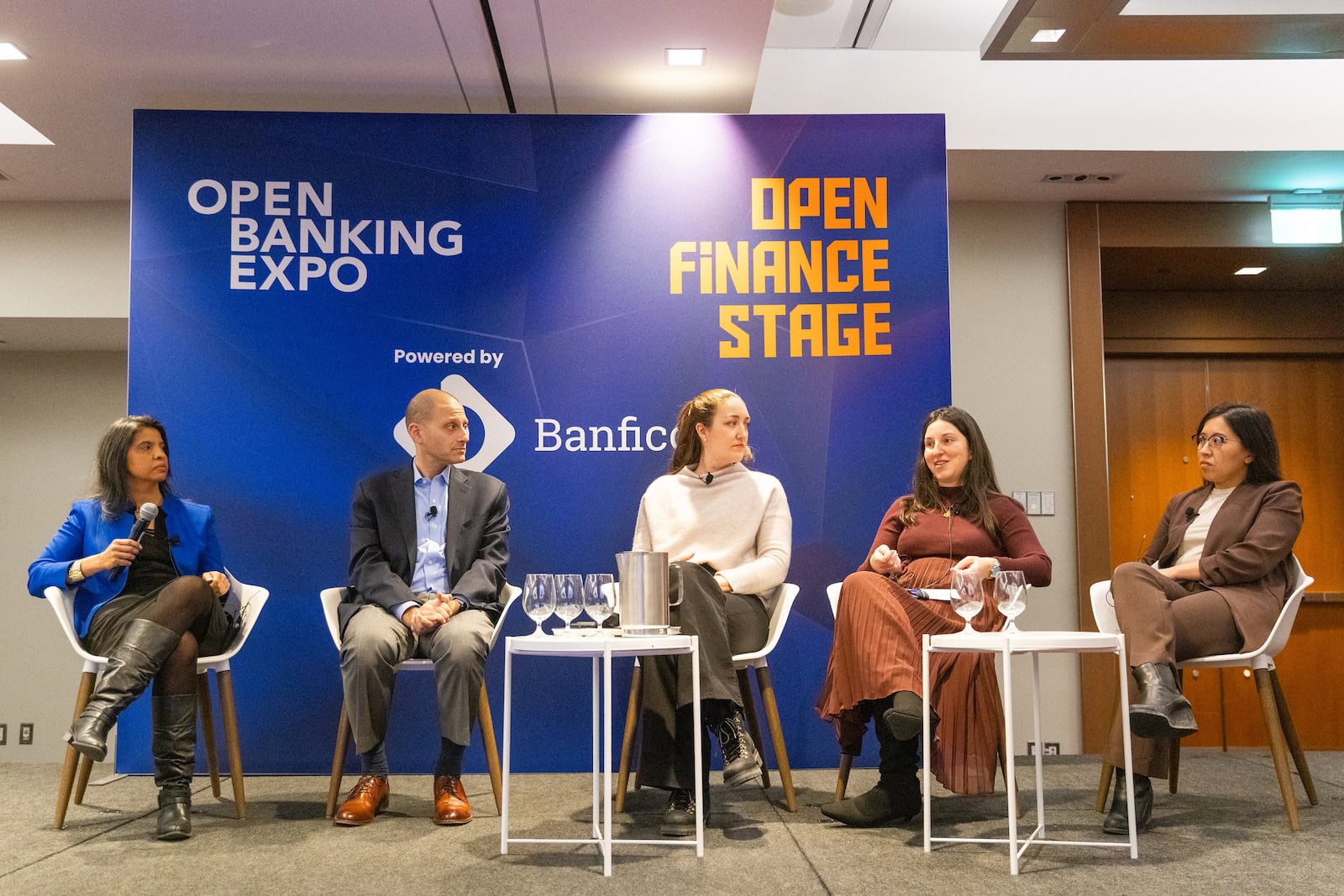
At Open Banking Expo Canada, representatives from MX, FDATA, Wealthsimple and Borrowell examined what it will take to build a system that is not only functional, but trusted by consumers and viable for the organisations participating in it.
The discussion, moderated by Bhavna Kaushal, principal consultant at BK Advisory, reflected a shift in focus. After years of policy development, the conversation is about how Consumer-Driven Banking will work in practice, and where accountability will sit when data begins to move at scale.
A key starting point is the question of ownership. Maisie Bilotti, senior director of advocacy at MX, noted that Canada’s framework has now clearly established a legal foundation, recognising that financial data belongs to the consumer. However, she emphasised that ownership alone is not sufficient.
“In terms of practical control, once that data moves from a financial institution through an API, and it’s actually made its way to either another financial institution in some cases or to a fintech that the consumer wants to use, the practical control piece is about making sure that the data is cleansed, categorized, and presented to the consumer in a way that’s actually useful for them – to use that data right that they have to improve their financial life,” she told attendees.
Consent with clarity
Consent design was highlighted as one of the most immediate challenges.
Kaushal asked: “How should consent be designed for our consumers so that it’s not a checkbox exercise and it’s something meaningful?”
Speakers agreed that traditional approaches to consent, often characterised by lengthy terms and conditions, are unlikely to be effective in this context.
Delina Ivanova, director, growth data science at Wealthsimple, stressed the importance of clarity: “One of the things we talk about often is, how do we make it very easy for consumers to understand what are they giving us access to, but also what is the value of them giving us access to that information.”
She added: “We don’t collect data unless we have a corresponding product or service that’s going to benefit the consumer by us having access to that data.”
Samantha Tom, vice president, legal and general counsel at Borrowell, explained that it is “incumbent” on organizations to work with their design teams. After years of habitual “click to accept” behaviour, organisations will need to rethink how consent is presented, ensuring that key information can be understood quickly without overwhelming users, she noted.
At the same time, panellists cautioned against setting unrealistic expectations. Steve Boms, executive director at FDATA, argued that achieving perfect consumer understanding is unlikely, and that progress should instead be measured by continuous improvement.
“If the line that we’re trying to cross is to make sure 100% of consumers who are accessing Open Banking services understand 100% of the time what data is being accessed for what purpose and what their rights and responsibilities are, we are not going to achieve that goal,” said Boms.
“There’s a broader conversation to be had about how consent should be captured and collected and retained, but getting that perfect should not be the blocker to having us proliferate an Open Banking system in Canada, or anywhere else.”
Banning screen scraping
Beyond consent, the question of liability remains unresolved. While widely recognised as a critical component of the framework, speakers noted that there is still a lack of clarity around what liability actually means in a read-only system.
Boms pointed out that, unlike payment-enabled environments where financial loss can be clearly identified, the risks associated with data sharing are more complex. In the event of a data breach, it may be difficult to determine both the source of the breach and the extent of the resulting harm, raising questions about how responsibility should be assigned and enforced.
“This is an area where the government, in my view, really needs to set the guardrails of what we’re talking about in order to let the market then figure out how to apportion that liability practically,” he added.
The transition away from screen scraping also featured prominently in the discussion.
Borrowell’s Tom noted that screen scraping continues to serve as a fallback in cases where systems are not fully reliable, and that an outright ban should only be introduced once the new framework is demonstrably effective. Prematurely removing this capability, she warned, could limit participation and reduce competition, particularly for smaller fintechs with fewer resources.
“We should absolutely charge towards that outcome of banning screen scraping, but it’s a journey and we need to make sure that what we’ve built is actually working as intended,” she noted.
This tension between innovation and regulation was evident throughout the session. While Consumer-Driven Banking is expected to create new opportunities for both financial institutions and fintechs, it also introduces additional complexity, particularly in a more regulated environment.
Ivanova highlighted the operational challenges facing larger institutions, including legacy technology and complex infrastructure, which can limit their ability to respond quickly to new requirements. In contrast, digital-native organisations are often able to move faster, but may face new regulatory burdens as the framework evolves.
“I think in order for us to move forward… there has to be an incentive to invest in infrastructure, which currently doesn’t exist for a lot of the big banks,” said Ivanova.
Can Canadians embrace data sharing?
Looking further ahead, the panel considered how Consumer-Driven Banking might evolve into a broader data-sharing ecosystem. While there was optimism about the long-term potential, speakers also urged caution.
Boms noted that, despite recent progress, the core infrastructure for Open Banking has yet to be fully implemented. As a result, he argued that the immediate priority should be delivering a functioning system before expanding into more ambitious forms of data sharing.
“I’d like to see Open Banking and Open Finance built and then iterated into write access. Then, I think, that’s a great stepping stone for Open Data more broadly,” he suggested.
Others took a more optimistic view, suggesting that once consumers begin to experience the benefits of data portability, adoption may accelerate and open the door to wider applications.
However, Ivanova highlighted a more cautious consumer mindset in Canada, noting that many individuals remain hesitant to share financial data, particularly if they are uncertain about how it will be used.
She compared this to the US market, where “Americans are much more open to new things”.
“Generally, that market tends to be more open to trying new products. There is already a lot more competition,” Ivanova added. “But I think it’ll take some time to change that perspective here [in Canada] in our consumers.”
Watch the Live Lounge interview with FDATA’s Steve Boms, Maisie Bilotti of MX and Wealthsimple’s Delina Ivanova as they reflect on their session on the Open Finance Stage