

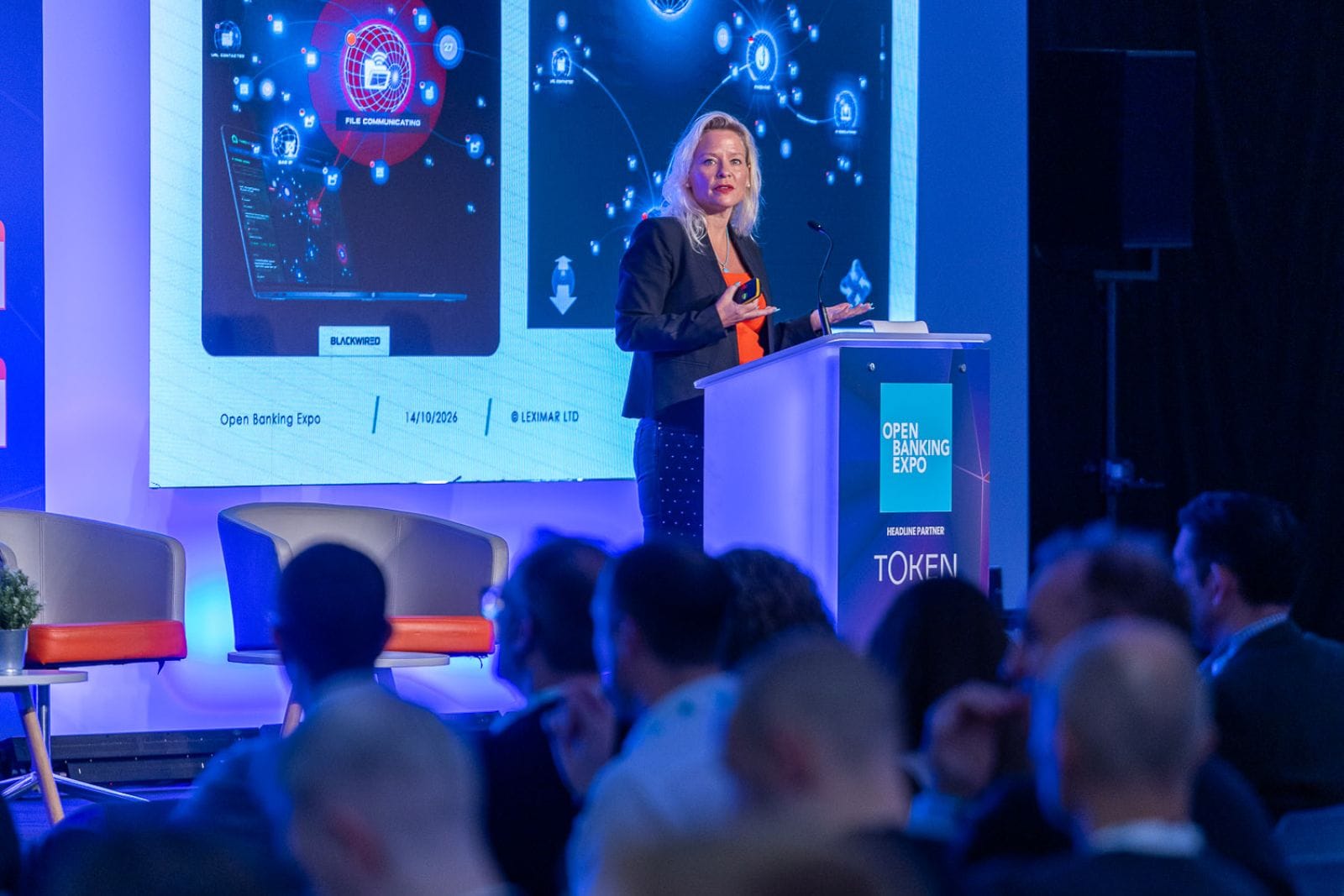
Banks and payments providers will need to rethink authentication, fraud prevention and customer relationships as artificial intelligence increasingly takes control of financial transactions, according to
Delivering the opening keynote on Day 2 of Open Banking Expo UK & Europe 2026 in London, Wandhöfer warned that the industry is moving towards a world in which AI agents make purchasing decisions, select payment methods and execute transactions without consumers directly interacting with their banking applications.
The shift, she argued, could fundamentally change who controls financial transactions and where value is captured across the payments ecosystem.
“What if the biggest threat to your payments business is not another payments business?” she asked delegates.
Wandhöfer described the emerging environment as a “post-payment world”, where payments become an almost invisible component of broader, AI-driven financial services.
Rather than competing primarily on transaction speed or payment infrastructure, financial institutions could increasingly find themselves competing to influence the decisions that cause money to move.
Traditional authentication faces an AI challenge
Wandhöfer warned that existing security frameworks were designed around human behaviour and may struggle to accommodate transactions initiated by autonomous software.
“AI agents behave differently; they don’t have human biometrics,” she said.
She argued that strong customer authentication requirements, developed around customers actively approving individual transactions, would need to evolve to support delegated financial authority.

Dr Ruth Wandhofer, fintech professor and chief executive officer of Leximar
“You need machine-readable consent policy frameworks, and you need to understand how the risk pattern is shifting as you have machines in the game.”
AI agents will also introduce new cybersecurity challenges, including the potential for malicious instructions, compromised agents and large numbers of automated transactions placing unexpected pressure on financial systems.
Wandhöfer highlighted prompt injection as a particular concern, warning that agents could be manipulated into performing actions outside their intended purpose.
She said financial institutions would need to establish reliable mechanisms to verify an AI agent’s identity, confirm its authority to act and maintain an auditable record of its decisions.
“Trust is good. Evidence is better,” she told delegates.
The emerging requirements extend beyond conventional fraud detection, which frequently relies on behavioural signals associated with human users and their devices.
Banks risk losing control of the customer relationship
Alongside the security challenges, Wandhöfer warned that AI could fundamentally reshape competition between banks, fintechs and payment providers.
In a world where an AI agent identifies a customer’s needs, selects products and executes payments, consumers may no longer interact directly with the financial institution providing the underlying service.
This could weaken traditional advantages built around customer interfaces, brand visibility and ownership of the payment journey.
“For the Open Banking world, access alone does not guarantee value capture,” she said.
Wandhöfer suggested that agentic AI could accelerate the adoption of Open Finance by enabling automated financial management, lending decisions, treasury operations and working capital services.
It could also encourage greater competition between payment methods, including account-to-account payments, cards and emerging forms of digital money.
However, she stressed that the transition would not happen overnight, with regulation, fragmented data, legacy infrastructure and consumer protection presenting significant obstacles.
A new architecture for financial services
Wandhöfer outlined an emerging financial ecosystem built around four interconnected elements: AI agents, digital money, tokenisation, and trust and regulation.
She argued that competitive advantage would increasingly depend on the ability to coordinate data, intelligence, financial decisions and execution, rather than simply providing access to accounts or faster payment rails.
The development of reliable digital identity systems for AI agents would be particularly important, alongside clearer rules governing consent, accountability and liability.
Wandhöfer also emphasised that human oversight would remain necessary, particularly when establishing the boundaries within which AI agents are permitted to act.
Looking ahead, she challenged financial institutions to consider how their business models would remain relevant as AI assumes a greater role in financial decision-making.
“Who will own the decision layer?” she asked.
“Who will orchestrate the new financial ecosystem?”
Her message was that Open Banking has created the foundations for a more connected financial system, but the next phase of competition may be determined by who controls the intelligence operating on top of it.