


Mutual banks favour partnering with fintechs for Open Banking data recipient use cases where this “generates more customer value”.
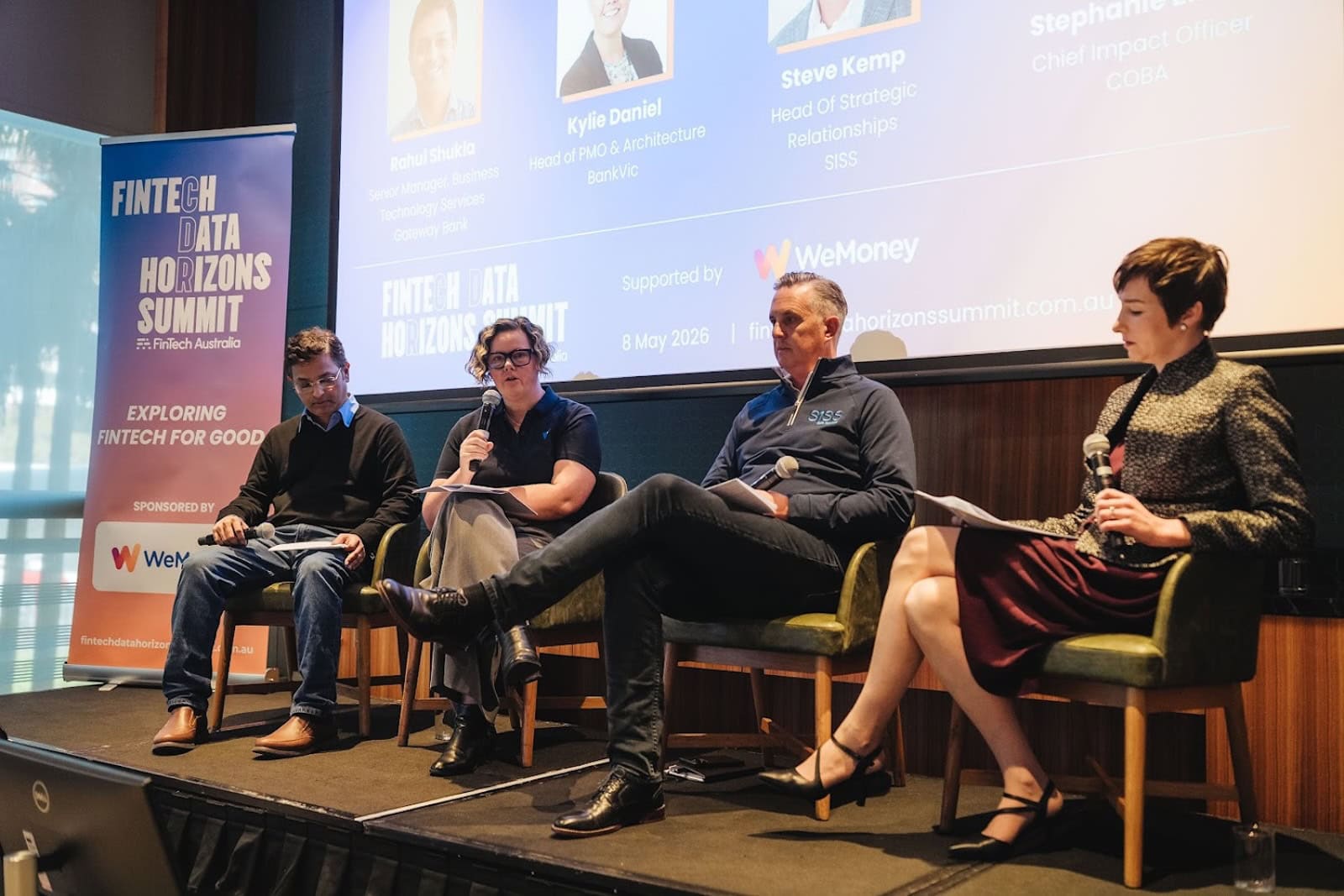
This was the key message from a panel at the Fintech Data Horizons Summit hosted on Friday, 8 May 2026 by FinTech Australia in Sydney.
Potential use cases include faster loan approvals, lower fraud and scams risk if Australian Taxation Office (ATO) data is available for income verification, ensuring victim-survivors of financial abuse need only tell their story once, real-time comprehensive credit reporting, and integration with accounting platforms for businesses.
Stephanie Elliot, chief impact officer at the Customer Owned Banking Association (COBA), moderated a discussion on moving from ‘Compliance to Growth: Pricing, Platforms and Sustainable Open Banking Models’.
Elliott prefaced the conversation with the observation that small banks and fintechs have a lot in common, being challengers in a market dominated by larger institutions, responding to regulatory and commercial pressures, and maintaining thriving team cultures.
Her panellists were Rahul Shukla, senior manager technology services at Gateway Bank, Kylie Daniel, head of PMO and architecture at BankVic, and Steve Kemp, head of strategic relationships at accredited data recipient SISS Data Services.
Elliott’s first question to the panel was whether Open Banking is being used to create something customers value and banks can sustainably deliver.
Gateway’s Shukla responded with a note of frustration around the specific number of changes there have been in Open Banking since it commenced with the big four banks on 1 July 2020 and progressively extended to other banks during 2021-22.
The rules which govern the Consumer Data Right (CDR) regime were last amended on 4 March 2025, being the “Version 8” amendments, to expand CDR to the non-bank lending sector from 2025 onwards.
“They can announce something and it completely wrecks your pipeline for two years,” Shukla said.
He also commented: “ROI does not always stack up” every time there is a change to the regime rules or data standards.
The panel then turned to the question of mindset – whether banks are too focused on compliance costs in their position as “data holders,” rather than taking action to benefit commercially as “data recipients”.
Speaking for SISS Data Services, Kemp advocated education, as a big part of his role is talking with banks about the upside of Open Banking.
BankVic’s Daniel said she would like to see more focus on levers that deliver value to the bank – and its customers – such as saving time, reducing cost and managing risk, then working backwards to data sets available in Open Banking to generate that value.
Shukla said he supported extending CDR to include ATO data, and using digital identity, to enable the continuous assessment of high and moderate risk customers.
Small business and lending use cases have the most value
Elliott asked the panel to talk through their most valuable use cases for Open Banking and CDR.
Kemp said he sees the most value in the small business accounting use case, which is a designated high-value priority use case for the CDR reset.
He supports ATO data being included in CDR, so that small business obligations around PAYG and BAS can be more easily complied with and accounted for.
“That’s the big change we need quickly,” Kemp said.
“We don’t need insurance or superannuation yet,” he added.
For BankVic’s Daniel, the most value lies in lending, especially helping customers apply for financial hardship.
“It’s a positive way to reduce friction for vulnerable members,” Daniel said.
Other data sets like Comprehensive Credit Reporting are not aligned
Gateway’s Shukla noted the clear difference between access to real-time Open Banking data versus the Comprehensive Credit Reporting (CCR) regime.
He cited the common experience of borrowers closing out credit cards prior to applying for a home loan, usually on the recommendation of a mortgage broker, to concentrate borrowing power on the mortgage.
Unfortunately, he said, CCR data can be a month old, and is therefore not as reliable as Open Banking.
“Is there a future where CCR can be like Open Banking – or even combined with it – so we can have that data in real time?” he asked.
Bank trust is essential to promote Open Banking
Kemp underscored the trusted position of banks with respect to money and data.
“We need the party that has the trust to be front and centre in the communication about Open Banking,” Kemp said.
Bank officers and websites can do more “to explain what CDR is and why customers are being asked to do something”, he added.
Daniel agreed: “We have a core bond. We’re speaking to our members all the time and it’s important when we’re talking about Open Banking that we explain what’s in it for them and not just rely on their trust to take an action.”
Shukla added: “Our members are not just account numbers. We have a long history with them.”
Fintech partnerships offer more value than becoming an ADR
Banks have had a simplified data recipient approval pathway available since February 2022 and a data handling exemption since November 2024.
“This is still a wish,” Shukla said, seeing no competitive advantage in becoming an Accredited Data Recipient (ADR), despite there being a simplified pathway for banks.
“Customers need actionable insights, not just more data,” he said.
Daniel agreed there is no need to become an ADR to get value from Open Banking data.
“You can partner with SISS, for example,” she said.
Kemp, who held senior leadership positions in business banking before moving into fintech, said: “Mutuals don’t want to become ADRs due to the extra compliance and risk.”
“Mutuals like the ‘plug-and-play’ approach and it makes a lot of sense to partner with a fintech,” he said.
Daniel noted BankVic does not have the capability to build Open Banking-enabled apps in-house.
“We will always look to partner,” Daniel said.
“If we can reduce the friction to access CDR, and power Open Banking journeys more broadly, the growth will happen,” she concluded.
Jennifer Harrison is director, startups and scaleups at Reputation Edge

