
Canada’s Consumer-Driven Banking framework may be approaching implementation, but the industry is already considering what comes next.
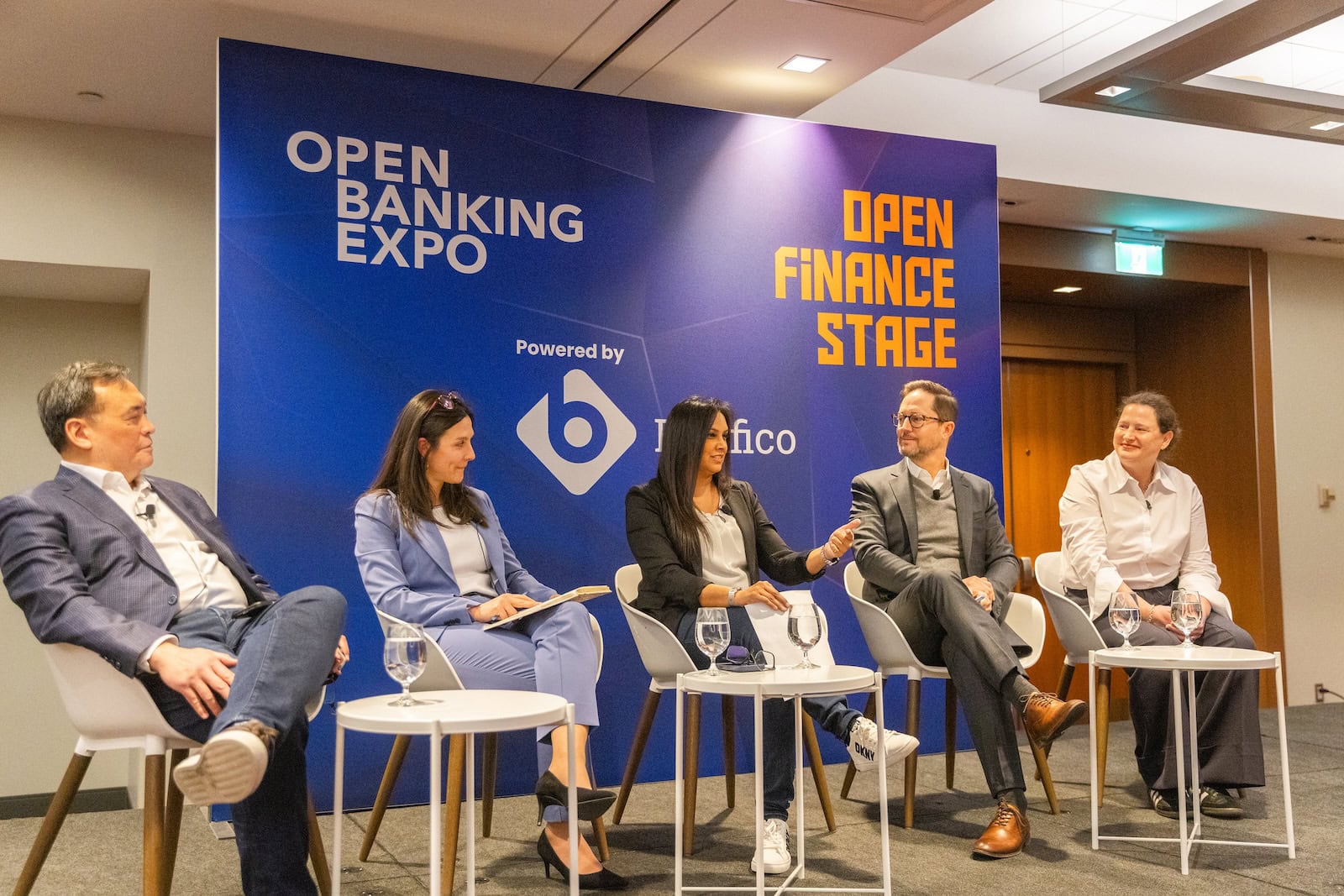
At Open Banking Expo Canada 2026, a panel of senior leaders from National Bank of Canada, ATB Financial, RBC and Meridian Credit Union examined whether the country is ready to move beyond Open Banking and unlock the broader potential of Open Finance.
The discussion, moderated by Roy Kao, principal at Elja Associates, focused on how financial data sharing could evolve beyond traditional banking products to include areas such as wealth, insurance and pensions, and what that expansion would mean for consumers, institutions and the wider economy.
“[Open Finance is] looking beyond Open Banking, which remains to be fully realized, but it’s certainly on its way – more so than the past few years, for those of us who have been very patient and been part of the journey. We’re finally ready to look at the future beyond banking into the general financial services ecosystem,” said Kao.
A central theme throughout the debate was that Open Finance should not be viewed as a simple extension of Open Banking, but as a more fundamental shift in how financial services are delivered.
Neela Maharaj, director, digital product and strategy, Open Banking and APIs at RBC, noted that Open Banking, Open Finance and Open Data should be seen as part of a layered progression, rather than distinct phases.
“We have Open Banking and within [that], we’ve got phasing of products and data… things like read access, write access, and then moving into payments,” Maharaj explained. “And then we can start building on top of that. So, I think it’s important to recognize that we need to get the foundation completely right before we actually start building Open Finance.”
Panellists repeatedly emphasised that the success of Open Finance will ultimately be determined by outcomes, not infrastructure. Natacha Boudrias, leader of National Bank of Canada’s Open Banking strategy, highlighted that consumers are not motivated by data sharing itself, but by the benefits it enables.
“People and consumers don’t wake up in the morning wanting data sharing. What they want is better advice, faster decisions, access to money,” she told attendees. “So Open Finance will work when people are able to use the framework to have a better financial situation and to have access to more services.”
This focus on outcomes was echoed across the panel, with speakers stressing that Open Finance should become largely invisible to users. Rather than being a standalone concept, it should be embedded within products and services in a way that delivers clear and tangible value.
The discussion also explored what Open Finance could look like in practice. While expanding access to additional data sets, such as investments and insurance, was identified as one direction, there was also a strong view that the definition should be driven by real-world problems.
ATB Financial’s Victoria Clark, associate vice president, payment products, suggested that a more ambitious approach could involve incorporating data beyond traditional financial services, including government-held data such as tax information or business registries, which in turn, could significantly improve access to capital for small businesses.
She continued: “Banks are spending a lot of time and effort right now pushing data out into accounting software to support clients in the accounting space. But imagine if we were able to take all that aggregated data, bring it back to the bank to support cash flow and lending needs to support small business growth in this country.
“I’m just hopeful that we start to think about expanding that definition of what Open Finance is.”
For financial institutions, Open Finance presents both opportunities and challenges. Matthew Seagrim, chief digital and marketing officer at Meridian Credit Union, highlighted the potential to deliver more holistic advice by accessing a broader view of a customer’s financial situation. However, he also noted that this capability will be available to competitors, increasing the importance of differentiation and execution.
“This sector of financial services in Canada is unbelievably collaborative,” Seagrim said. “And there’s a huge opportunity for us to be moving to build more competition in Canada, to build more value for Canadians, and to create richer products and services that are going to make the whole market better.”
The panel agreed that collaboration between institutions and fintechs will play a central role in shaping the future ecosystem. While incumbents retain advantages in scale and trust, fintechs bring speed and innovation, and the combination of both is likely to drive the most meaningful progress.
Adoption emerged as one of the most significant challenges ahead.
Boudrias noted: “Launching is the first thing – getting people into the ecosystem and using it is the real test. Adoption will tell us how fast we’re going to be able to move forward into the ecosystem.
“Open Finance is not about data sharing per se, or expanding the scope of data. It’s about improving the financial situation in Canada.”
RBC’s Maharaj agreed: “It’s about making sure Canadians are set up for success as it comes down to financial wellness. Making sure that they have access to things like credit when they need it and that it doesn’t take forever for them to get access to – let’s assume they’re a landed immigrant – funds, so they can live day to day.
“These are the things that we need to focus on and make sure that we’re adding value for clients.”
Speakers pointed out that consumers are unlikely to engage with Open Finance as a concept. Instead, adoption will be driven by compelling use cases that solve real problems, whether that is improving access to credit, simplifying financial management or reducing fraud.
“I think we need to make sure we’re doing this in a really user-friendly way,” added Seagrim. “We’re putting control in people’s hands, but it’s also got to be relatively easy for people to understand how to control what they’ve been given permission to.”
Further reading: From Open Banking to Open Everything: Building Canada’s Smart Data future