

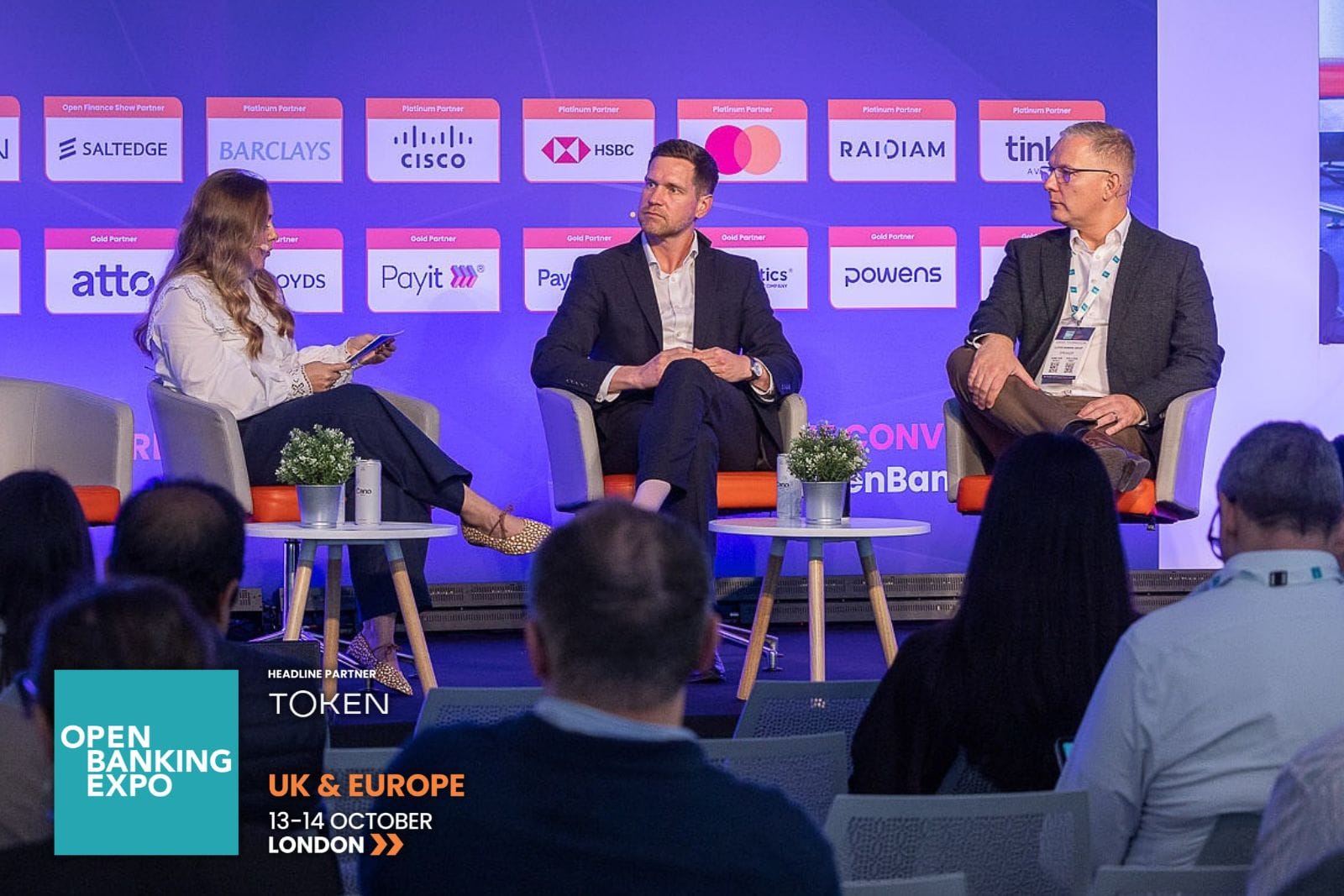
Lloyds Banking Group and Visa have highlighted how Open Banking is being embedded into everyday financial journeys, from investment account funding and corporate payments to new opportunities for automated money movement.
Lloyds Banking Group is expanding its use of Open Banking payment capabilities across retail, business and commercial banking, as financial institutions increasingly focus on making money movement simpler and more integrated into customers’ everyday activities.
Speaking at Open Banking Expo UK & Europe 2026, David Thomasson, managing director of business transaction banking at Lloyds Banking Group, outlined how the bank is using Open Banking technology to support a growing range of payment journeys.

Dominique Cranstone, senior account manager at Visa.
He was joined by Jack Spiers, senior director, issuing and risk at Visa, for the Fireside Chat Beyond payments: Scaling payment innovation across banking, moderated by Dominique Cranstone, senior account manager at Visa.
The discussion explored how customer expectations, technology investment and partnerships are helping financial institutions introduce new payment capabilities at scale.
Open Banking becomes part of a broader payments strategy
Thomasson explained that customers increasingly compare their banking experiences with the seamless digital services they encounter elsewhere.
Rather than treating payments as separate transactions, consumers and businesses expect them to be integrated into the activities they are already undertaking.
“Payments [are expected] to be part of a journey rather than a separate standalone,” he said.
Thomasson emphasised that Open Banking payments should complement existing payment methods, rather than compete directly with cards or Direct Debit.
“It’s just one of many options,” he said.
Spiers agreed that successful payment innovation starts with identifying the most appropriate solution for a particular customer journey.
He pointed to wallet top-ups and credit card repayments as examples where Open Banking has already addressed practical problems by reducing friction.
For Visa and Tink, he said, the objective is not to promote one payment method over another, but to ensure customers can access the options that best suit their needs.
Lloyds expands Open Banking into investment and corporate banking
Thomasson shared examples of how Lloyds is applying Open Banking technology across different parts of its business.
Working with wealth and insurance partners, the bank has introduced capabilities that allow customers opening investment accounts, including ISAs, to verify account ownership and make an initial payment within the same journey.

David Thomasson, managing director of business transaction banking at Lloyds Banking Group
Embedding these steps can improve account activation and make subsequent funding more convenient.
The bank is also supporting large corporate customers that hold accounts with multiple financial institutions.
Using Open Banking technology, businesses can move funds between their own bank accounts without having to leave their enterprise resource planning (ERP) systems and access separate online banking platforms.
Thomasson described the capability as a relatively straightforward improvement that is already delivering benefits.
“It’s a simple thing, but it’s working really, really well,” he said.
These applications demonstrate how Open Banking can support a wider range of banking activities beyond consumer checkout payments.
Building infrastructure that can support multiple use cases
Scaling innovation across a major banking group requires more than introducing individual payment features.
Thomasson explained that Lloyds has focused on establishing core technology, resilience and governance before extending the same underlying capabilities into different customer journeys.
Working with Tink, the bank initially developed payment functionality for simpler use cases before expanding into credit card repayments and subsequently business and commercial banking.
The approach allows Lloyds to build on its existing investment rather than developing separate infrastructure for every new application.
Thomasson said the bank now wants to extend the benefits of these capabilities beyond large corporate customers.
“If we can start to open this up and provide the same sort of capability to the smaller businesses in the world that really are the people that power this country, the greater the ripple effect,” he said.
He also invited software platforms, ERP providers, payment gateways and other potential partners to collaborate with Lloyds on developing solutions for shared customers.

Jack Spiers, senior director, issuing and risk at Visa
Spiers praised the bank’s approach to implementation, highlighting the importance of balancing long-term planning with practical delivery.
“Moving slow to move fast has been the one thing that I think they’ve nailed,” he said.
Partnership combines banking relationships with payment technology
The discussion also highlighted the importance of collaboration between banks and technology providers.
Spiers explained that Tink’s role is to provide the underlying technology and expertise that enable financial institutions to offer seamless payment journeys.
This includes supporting partners with customer experience design, testing and improving the proportion of users who successfully complete a payment.
He described Lloyds’ established customer relationships as an important complement to Tink’s technology.
“They own the trust with the customer,” Spiers said.
“They own the relationship with the end user or the business.”
Thomasson similarly emphasised that partnerships are most effective when they are built around clear customer outcomes rather than technology adoption alone.
He pointed to Lloyds’ relationships with Visa and Tink as examples of how combining scale, customer understanding and specialist capabilities can help bring payment innovation into everyday banking.
The future of payments could mean money on autopilot
Looking ahead, both speakers anticipated further changes in how money moves between accounts, platforms and financial products.
Thomasson predicted that payments will become increasingly embedded within digital experiences, supported by developments in account-to-account payments, data, digital identity and potentially AI agents.
He also acknowledged the emergence of new technologies, including stablecoins, while emphasising the continuing importance of established payment methods.
For Spiers, variable recurring payments (VRP) and AI-driven financial services could enable more proactive money management.
He described a future in which money could be moved automatically between accounts to help customers achieve financial goals, such as reducing mortgage costs or adjusting investments.
“The future of money is going to be money on autopilot,” he said.
However, both speakers stressed that innovation must be accompanied by appropriate security, fraud prevention and risk controls.
Spiers highlighted the need for scalable infrastructure capable of supporting growing payment volumes, while Thomasson emphasised the importance of ensuring that customers understand and trust new capabilities.
As financial services become more connected, the discussion suggested that the next stage of payment innovation will be defined less by individual payment methods and more by how effectively they work together.
For Lloyds Banking Group and Visa, the priority is to combine customer insight, trusted banking relationships and technology partnerships to make payments more convenient, accessible and integrated into everyday financial experiences.